
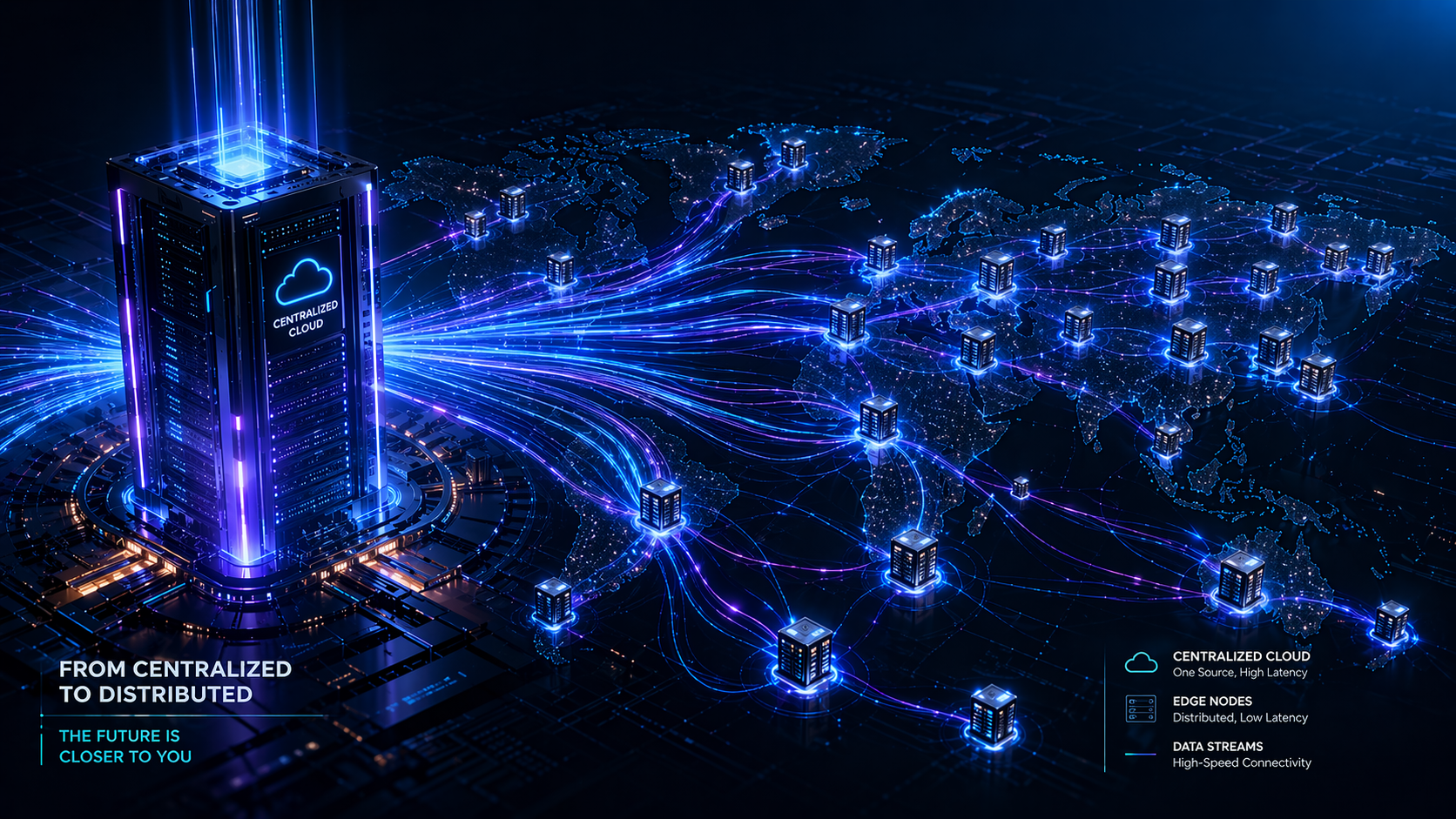

For the last fifteen years, the tech industry has operated under a single, unifying mantra: Move it to the cloud.
We took our servers out of local closets and data centers and migrated them to massive, centralized server farms managed by AWS, Google, and Microsoft. Centralized cloud computing gave us unprecedented scale, reliability, and ease of use. It changed how we build software forever.
But the pendulum of computing is swinging again.
As our applications become more interactive, our user bases more global, and our data privacy laws more stringent, the centralized cloud is starting to show its physical limitations. You can optimize your database queries and minimize your bundle sizes all you want, but you cannot change the speed of light. If your server is in us-east-1 (Virginia) and your user is in Tokyo, there is an unavoidable physical latency that degrades the user experience.
The solution isn't to build a faster centralized server. The solution is to move the server closer to the user.
Welcome to the Edge Computing Revolution.
Why I'm Making the Shift to the Edge
My name is Jojo Lagrimas, and I am a software engineer and infrastructure architect. Over the course of my career, I've built and scaled applications using traditional centralized cloud infrastructure. I've dealt with the complex VPC routings, the unpredictable cold starts of traditional serverless, and the painful egress fees that come with serving global traffic.
Recently, I began transitioning my architecture to the edge, primarily utilizing the Cloudflare ecosystem (Workers, KV, Durable Objects, and D1).
The results have been paradigm-shifting. By running compute, state, and routing logic directly on the edge nodes—just milliseconds away from the end-user—I've seen dramatic drops in Time to First Byte (TTFB), eliminated cold starts, and simplified my deployment pipelines.
Edge computing is no longer just a buzzword used for CDN caching. It is a fully-fledged compute environment capable of running modern, data-rich applications.
What to Expect in This Series
I am publishing this multi-part series to document this transition. Whether you are a CTO looking to cut cloud costs, a system architect designing for global scale, or a developer curious about the future of the web, this series is for you.
We will move from the theoretical and historical context straight into practical, hard-won engineering lessons.
Here is the roadmap for the series:
- Part 1: The Genesis of the Edge – Tracing the history of computing to understand why the cloud is moving closer to home.
- Part 2: The Pioneers – How telcos, streaming giants, and IoT early adopters built the first edge networks.
- Part 3: Modern Edge vs. Centralized Cloud – A definitive breakdown of latency, egress costs, and the shifting security perimeter.
- Part 4: Living on the Edge (My Cloudflare Journey) – A deep dive into my personal use case, replacing heavy middleware with Cloudflare Workers and Edge-native databases.
- Part 5: Modern Day Edge Applications – Exploring what developers are building today that was impossible five years ago (Edge AI, Edge-Side Rendering, real-time multiplayer).
- Part 6: The Future of the Edge – Looking ahead at WebAssembly (Wasm), the local-first movement, and the hyper-distributed web.
Join the Journey
The transition from the centralized cloud to the distributed edge is the most significant architectural shift since the invention of AWS. I am excited to share what I've learned, the mistakes I've made, and the code I've written along the way.
Subscribe to my newsletter to get Part 1 delivered straight to your inbox next week, along with exclusive code snippets and architecture diagrams.
Stay tuned. Part 1: "The Genesis of the Edge" drops next week.