
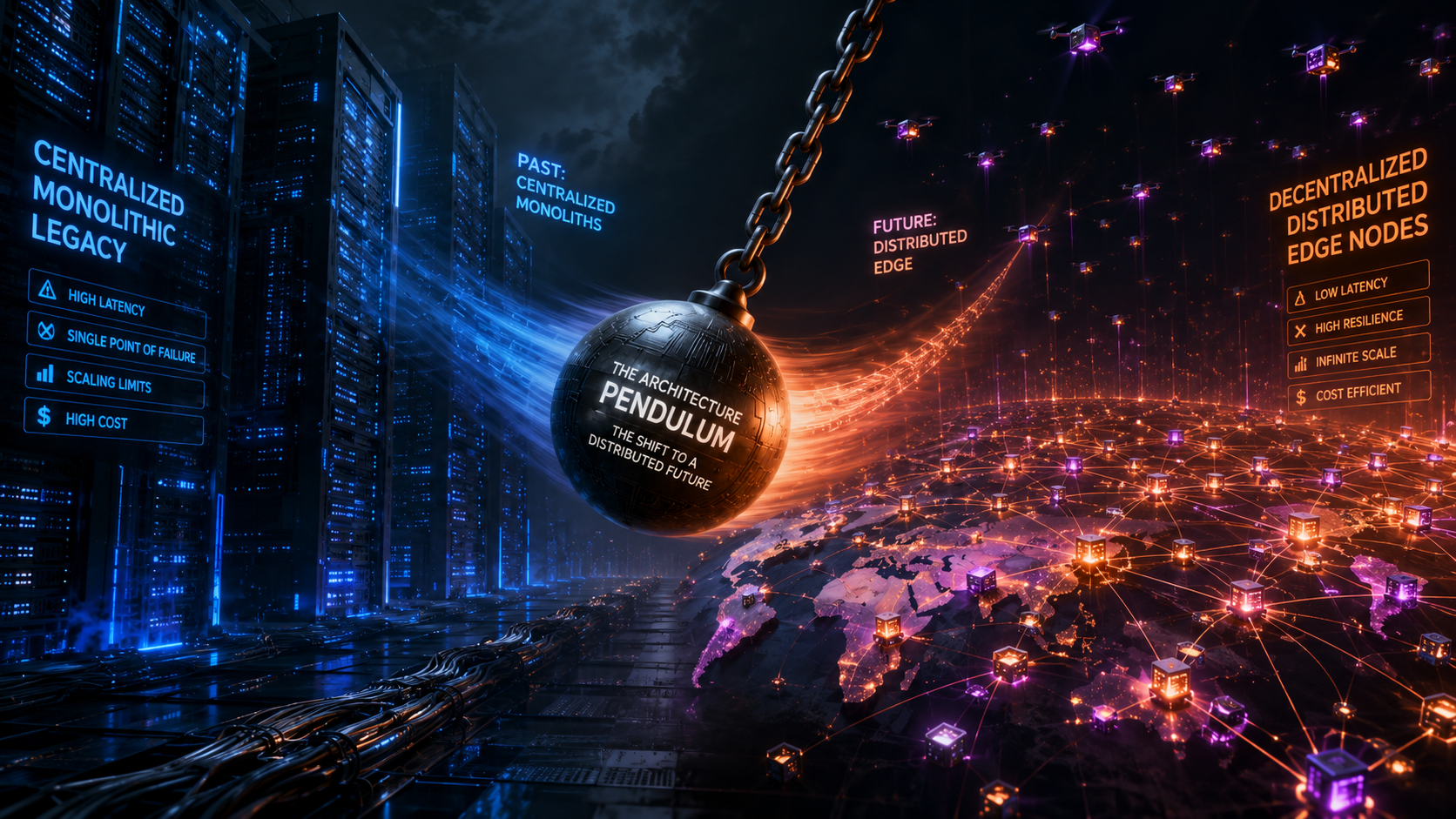

If you zoom out far enough, the history of computing looks like a giant pendulum swinging back and forth between centralization and decentralization.
In the 1960s and 70s, we had mainframes (centralized). You connected via a "dumb terminal" that did no processing of its own. Then, the 1980s and 90s brought the Personal Computer revolution (decentralized). Suddenly, the processing power was sitting right there on your desk.
In the 2000s and 2010s, broadband internet allowed the pendulum to swing back with incredible force. We took the processing power off our desks and put it into massive, football-field-sized data centers. We called it "The Cloud." We built sprawling monolithic applications, deployed them to regions like AWS us-east-1 in Virginia, and forced users around the globe to travel across the ocean to fetch their data.
But today, in 2026, the pendulum is swinging back again. The centralized cloud is hitting a wall—not a wall of compute power or storage, but a wall built by the unchangeable laws of physics.
To understand where we are going with the Edge Computing revolution, we first need to define what the Edge actually is, and look at the history that forced its creation.
Defining "The Edge"
The term "Edge Computing" gets thrown around in marketing copy a lot, often blurring the lines with IoT or 5G. Let's simplify it.
If Cloud Computing is processing data in a massive, centralized mega-data center located hundreds or thousands of miles away from the user...
And Fog Computing is processing data at local regional nodes (like a city-wide telecommunications gateway)...
Then Edge Computing is processing data at the absolute nearest logical point to the user or the data source.
This could be a Cloudflare Point of Presence (PoP) sitting in an ISP data center right in your user's home city. It could be a server rack bolted to the floor of a manufacturing plant. It could even be the smartphone in the user's pocket. The "Edge" is simply the frontier of the network.
A Brief History: Solving the "World Wide Wait"
The concept of the Edge isn't actually new; it's an evolution.
In the late 1990s, the internet was struggling. As images and early multimedia became popular, the strain of sending heavy files from a single origin server to users worldwide caused massive bottlenecks. It earned the nickname the "World Wide Wait."
Enter the Content Delivery Network (CDN), pioneered by companies like Akamai. They realized that if you cached static assets (like a .jpg logo) on servers strategically placed around the world, users could download the image from a server in their own city rather than waiting for a response from halfway across the globe. This was the first iteration of the Edge: Static storage at the perimeter.
By the 2010s, the explosion of the Internet of Things (IoT) forced the next evolution. We were putting sensors on everything—jet engines, factory robotic arms, oil rigs. A single modern factory could generate terabytes of data a day. Sending all that raw data back to a centralized cloud for processing was not only absurdly expensive (bandwidth costs), but it was also too slow. If a robotic arm goes out of alignment, the system needs to shut it down in 10 milliseconds, not 200 milliseconds.
This birthed the "Compute Edge"—pushing actual logic and decision-making to the local network.
The Centralized Cloud and the Speed of Light Problem
So why is this becoming mainstream now for web developers and software engineers? Because user expectations have changed, and the centralized cloud has a latency floor we cannot cross.
Consider a user in Manila trying to access a SaaS application hosted in a central data center in Virginia, USA.
Data travels through fiber optic cables at roughly 200,000 kilometers per second (about 2/3 the speed of light in a vacuum). The physical distance between Manila and Virginia is roughly 14,000 kilometers. That means the absolute physical minimum time it takes for a packet of data to travel there and back is around 140 milliseconds.
Add in the real-world delays of routers, switches, congested sea cables, TLS handshakes, and database query times, and your user is easily looking at a 300 to 500-millisecond delay for every single interaction.
In modern web applications, half a second of latency feels sluggish. It breaks the illusion of a seamless, app-like experience.
Furthermore, cloud providers charge heavily for egress bandwidth—the cost of moving data out of their data centers. Routing all global traffic through a central hub is no longer just a performance liability; it is an economic drain.
The Paradigm Shift
We can't change the speed of light, so we must change the architecture. We have to move the server to the user.
Modern Edge Computing (which we will explore heavily in this series through platforms like Cloudflare) allows us to take our backend logic, our APIs, and even our databases, and distribute them globally. When that user in Manila clicks a button, the code executes in a data center right there in Manila.
The cloud isn't dead, but its role is shifting. It is becoming the asynchronous, heavy-lifting backend, while the Edge becomes the high-speed, synchronous, user-facing application layer.
In the next article, Part 2: The Pioneers, we'll look at the early adopters who paved the way for this shift—how streaming giants and telecom companies quietly built the foundation of the modern Edge before it was cool.
Next up: Part 2: The Pioneers – Who Moved to the Edge First, and Why?